Homeownership is more than having a place to live it's also one of the largest financial assets many people build over time. As home values increase and mortgage balances decrease, equity grows. A reverse mortgage provides eligible homeowners with an opportunity to access a portion of that equity through a financing solution designed to support a variety of financial goals.
While reverse mortgages have been available for many years, they continue to be misunderstood. Many homeowners assume the program is only for those facing financial hardship, but that is far from the truth. Today, reverse mortgages are often used as part of a broader financial strategy, helping homeowners create greater flexibility while remaining in their primary residence.
Whether you're a homeowner exploring your options or a real estate professional assisting clients, understanding how reverse mortgages work can open the door to valuable financing opportunities.
What Is a Reverse Mortgage?
A reverse mortgage is a financing solution that allows eligible homeowners to convert a portion of their home equity into available funds. Unlike a traditional mortgage, borrowers are not required to make monthly principal and interest payments on the reverse mortgage loan, provided they continue to meet all loan obligations, including occupying the home as their primary residence, maintaining the property, and paying applicable property taxes, insurance, and other required expenses.
Depending on the program, a reverse mortgage can be used to refinance an existing property or purchase a new primary residence. This gives homeowners additional flexibility when planning for retirement, relocating, downsizing, or managing long-term financial goals.
As with any mortgage program, eligibility, available proceeds, and loan terms are determined based on applicable guidelines and borrower qualifications.
How Can Home Equity Be Used?
Every homeowner has different financial objectives, and a reverse mortgage provides flexibility in how available funds may be used.
Some borrowers choose to supplement retirement income, while others use the proceeds to pay off an existing mortgage, complete home improvements, consolidate debt, or prepare for unexpected expenses. Others may use the program to purchase a home that better fits their lifestyle without tying up as much of their available savings.
Because every financial situation is unique, it's important to evaluate how a reverse mortgage fits into an overall financial plan before making a decision.
Key Features of the Reverse Mortgage Program
Today's reverse mortgage programs offer several features designed to provide financing flexibility while maintaining important consumer protections.
Program highlights include:
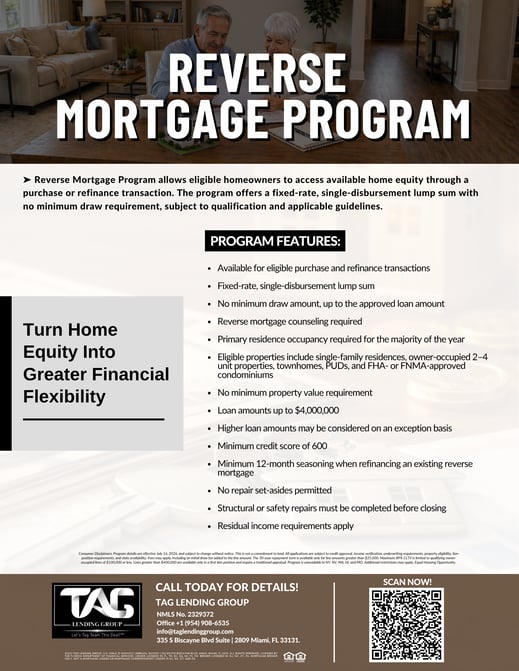
- Available for eligible purchase and refinance transactions
- Fixed-rate, single-disbursement lump sum
- No minimum draw amount, up to the approved loan amount
- Loan amounts up to $4,000,000
- Higher loan amounts may be considered on an exception basis
- Primary residence occupancy required
- Reverse mortgage counseling required before closing
- Eligible property types include single-family residences, owner-occupied two- to four-unit properties, townhomes, PUDs, and FHA- or FNMA-approved condominiums
- No minimum property value requirement
- Minimum credit score of 600
- Minimum 12-month seasoning when refinancing an existing reverse mortgage
- Residual income requirements apply
- Structural and safety repairs must be completed before closing
These guidelines help ensure borrowers fully understand the program while providing financing options that accommodate a variety of housing needs.
Understanding the Qualification Process
Although reverse mortgages differ from conventional financing, borrowers still complete a qualification process.
Lenders review factors such as occupancy requirements, financial qualifications, credit history, and property eligibility. In addition, borrowers must complete independent reverse mortgage counseling before closing. This counseling is an important consumer protection that explains how the program works, outlines ongoing responsibilities, and helps borrowers understand both the benefits and potential considerations.
Working with an experienced mortgage professional allows borrowers to evaluate available options and determine whether a reverse mortgage aligns with their financial goals.
Why Realtors Should Understand Reverse Mortgages
Reverse mortgages are not only valuable for homeowners—they can also become an important resource for real estate professionals.
Some buyers may believe they must pay cash or use traditional financing when purchasing a home later in life. A reverse mortgage may provide another financing option, allowing eligible buyers to purchase a primary residence while preserving more of their available assets.
For listing agents, understanding reverse mortgages can also create additional opportunities to help homeowners evaluate alternatives before deciding whether selling is the best solution. By knowing when a reverse mortgage may be appropriate, Realtors can offer more comprehensive guidance and connect clients with financing professionals who understand the program.
Choosing the Right Financing Solution
Every homeowner's financial situation is different, and no single mortgage program fits everyone. A reverse mortgage should be evaluated carefully alongside other financing options to determine whether it supports both short-term needs and long-term financial goals.
Understanding the available guidelines, property requirements, and borrower responsibilities is an important part of making an informed decision. With the right guidance, homeowners can better determine whether accessing home equity through a reverse mortgage is the right strategy.
At Tag Lending Group, we work with a nationwide network of trusted lending partners to help identify financing solutions tailored to each borrower's unique needs. Whether you're purchasing, refinancing, or exploring ways to leverage your home equity, our team is here to help you navigate your options with confidence.
Download Our Cheat Sheet!
.png?width=262&height=339&name=Christina%20mosquera%20Loan%20Programs%20(1%25%20Giveback).png)
%20(1).png?width=262&height=339&name=Christina%20mosquera%20Loan%20Programs%20(1%25%20Giveback)%20(1).png)

Unlocking Real Estate Success:
Tag Lending Group's Client Funnel Retention Program
In this dynamic video, we break down the essential components of our intake form and showcase how it empowers you to understand your return on investment, lead sources, and client demographics. Discover how we harness this data to fine-tune your marketing strategy and drive impressive results.🏠🔑
.png?width=500&height=647&name=TLG%20FLYERS%20(4).png)